IronBCI-32
32 channels of EEG over a single USB cable.
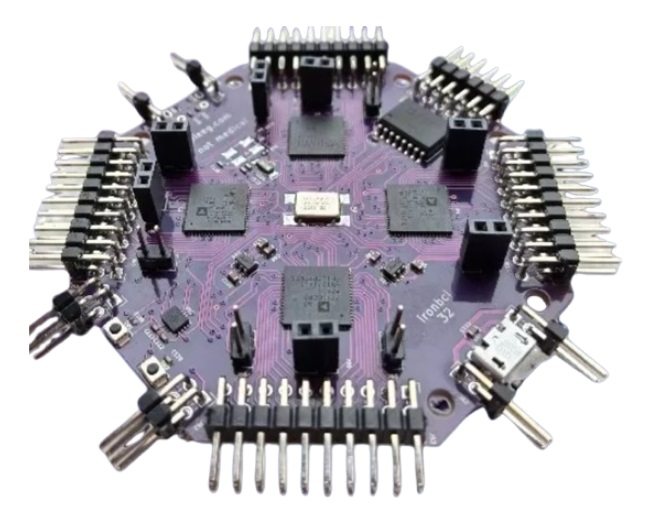
IronBCI-32 is a low-cost, open-source 32-channel, 24-bit biosignal acquisition board. Four 8-channel AD7771 converters measure EEG, EMG, ECG and EOG across the whole head, and an STM32H7 microcontroller streams all 32 channels to your laptop over USB. It works out of the box with BrainFlow, PiEEG Server and PiEEG Cloud.
⚠️
IronBCI-32 is not a medical device. Power it from a 5 V battery only, and run the laptop on battery too, unplugged from the wall. Read Safety before the first recording.
At a glance
| Channels | 32 biosignal inputs, plus reference and bias |
| Converters | 4 × AD7771, 8 channels each, 24-bit |
| Microcontroller | STM32H743 (Arm Cortex-M7) |
| Sample rate | About 500 SPS (BrainFlow reports 512 Hz) |
| Signals | EEG, EMG, ECG, EOG |
| Link to the computer | USB serial (virtual COM port), 921,600 baud |
| Electrodes | Dry or wet Ag/AgCl, 2.54 mm headers |
| Power | 5 V USB battery only, on its own USB port |
| Board | 70 × 70 mm, 4 layers |
| Software | BrainFlow (IRONBCI_32_BOARD), PiEEG Server, PiEEG Cloud |
How it works
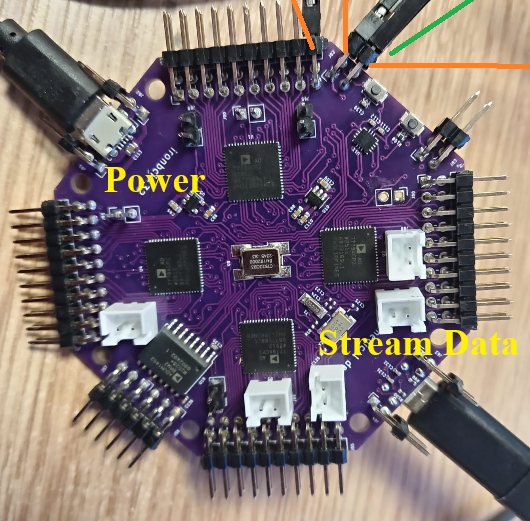
Two USB ports: one for power from a battery, one for data to a laptop.
 32 electrodes ──► 4 × AD7771 ──► STM32H7 ──USB──► Laptop (on battery)
 Ref + bias (ears)  (8 ch each)      ▲                ├ BrainFlow
                                     │                ├ PiEEG Server
5 V USB battery ──USB─────┘ └ cloud.pieeg.com- Measure: four AD7771 chips digitise 8 channels each, all 32 at the same moment.
- Send: the STM32H7 packs every sample into one frame and streams it over USB as a serial port. Streaming starts as soon as the board is powered.
- Use: read it in BrainFlow, PiEEG Server or the browser, in any language.
Which board?
| PiEEG-16 | IronBCI-8 | IronBCI-32 | |
|---|---|---|---|
| Channels | 16 | 8 | 32 |
| Host | Raspberry Pi | None (Bluetooth) | Laptop or desktop (USB) |
| Converters | 2 × ADS1299 | 1 × ADS1299 | 4 × AD7771 |
| Sample rate | 250 SPS | 250 SPS | ~500 SPS |
| BrainFlow | No | No | Yes |
| Best for | Pi-based research | Wearable, mobile | Full-head, high-density EEG |
What you can measure
| Signal | What it shows | Typical first test |
|---|---|---|
| EEG | Brain rhythms across the whole scalp | Close your eyes and watch alpha (8–13 Hz) rise at the back of the head |
| EMG | Muscle activity | Clench the jaw or a fist |
| ECG | Heart activity | Electrodes on the chest or wrists |
| EOG | Eye movement and blinks | Look left and right, blink |
See real recordings in Signals & Datasets.
Get started
Related
- BrainFlow: IronBCI32 (opens in a new tab): official board documentation
- PiEEG Server:
pip install "pieeg-server[ironbci32]" - PiEEG Cloud: stream IronBCI-32 in Chrome or Edge over Web Serial
- GitHub: ironbci-32 (opens in a new tab): SDK, firmware, schematic, Gerber files, dataset
- 3D-printable boxes (opens in a new tab) on Thingiverse
- Video demo (opens in a new tab)
- Buy on Elecrow (opens in a new tab)
Support
- Discord: discord.gg/5Ps24p47 (opens in a new tab)
- GitHub: github.com/pieeg-club (opens in a new tab)
- Email: pieeg@pieeg.com