MicroBCI
EEG with an STM32 development board.
MicroBCI is a low-cost shield for the STMicroelectronics NUCLEO-WB55 board. It measures 8 channels of biosignals (EEG, EMG, ECG and EOG) with a Texas Instruments ADS1299, and the STM32WB55 on the Nucleo streams them over Bluetooth LE to a computer, an Android phone or the browser. Ideal for embedded and STM32 developers who want to work with real biosignals.
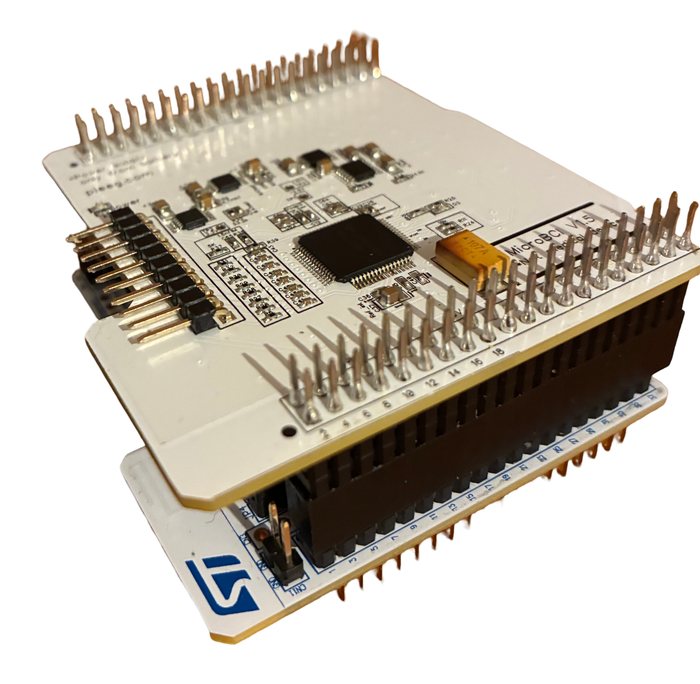
MicroBCI is not a medical device. Run it from a small 5 V battery only, never from a computer's USB port or a wall charger while electrodes are on a person. Read Safety first.
At a glance
| Channels | 8 biosignal inputs, plus reference and bias |
| Converter | TI ADS1299, 24-bit, simultaneous sampling |
| Sample rate | 250 SPS |
| Signals | EEG, EMG, ECG, EOG |
| Host | STMicroelectronics NUCLEO-WB55 (STM32WB55, not included) |
| Wireless | Bluetooth LE, same protocol as IronBCI |
| Electrodes | Dry or wet Ag/AgCl, 2.54 mm header |
| Power | Small 5 V power bank via the Nucleo's Micro-USB |
| Software | Python SDK, Android app, PiEEG Cloud, PiEEG Server |
How it works
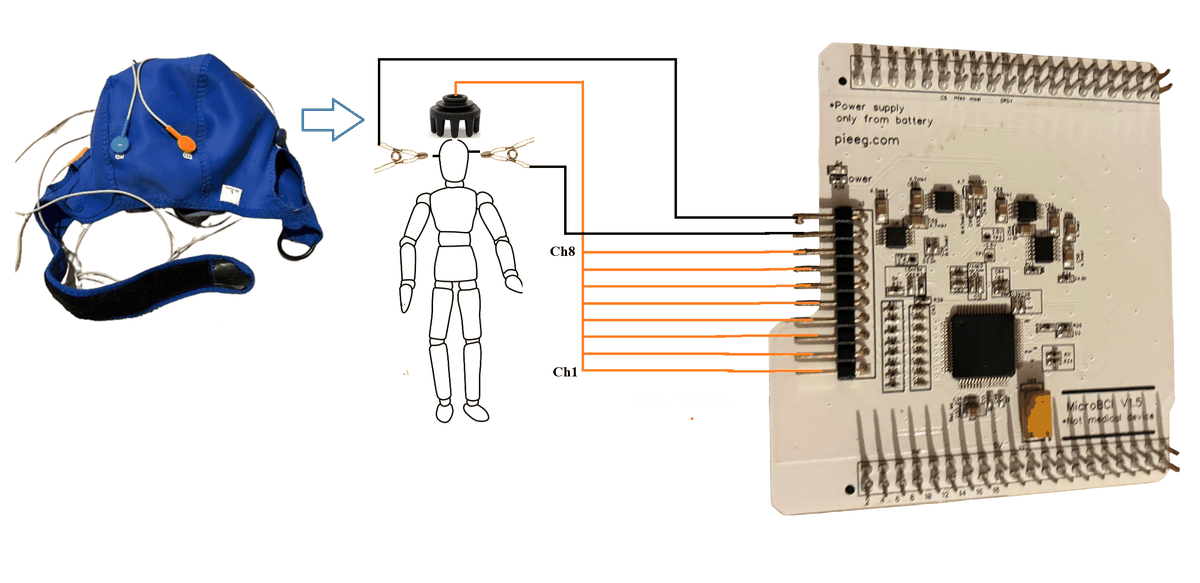
 Electrodes 1–8 ─┐
 Reference (ear) ┼─► MicroBCI ─SPI─► NUCLEO-WB55 ─BLE─► Python SDK
 Bias (ear) ─────┘   (ADS1299)       (STM32WB55)        ├ Android app
                                          ▲             ├ cloud.pieeg.com
5 V power bank ───────────┘ └ PiEEG Server- Flash once: load the Bluetooth stack and the MicroBCI firmware onto the Nucleo with STM32CubeProgrammer.
- Measure: the ADS1299 on the shield digitises all 8 channels, 250 times per second.
- Send: the STM32WB55 streams the samples over Bluetooth LE to your computer, phone or browser.
Which 8-channel board?
| PiEEG-8 | ardEEG | IronBCI-8 | MicroBCI | |
|---|---|---|---|---|
| Host | Raspberry Pi | Arduino UNO R4 WiFi | None | NUCLEO-WB55 |
| Link | On the Pi | Wi-Fi | Bluetooth LE | Bluetooth LE |
| Firmware | None | Arduino sketch | Pre-installed | Flash with STM32CubeProgrammer |
| Best for | Research | Education, Arduino projects | Wearable | STM32 development |
What you can measure
| Signal | What it shows | Typical first test |
|---|---|---|
| EEG | Brain rhythms | Close your eyes and watch alpha (8–12 Hz) rise |
| EMG | Muscle activity | Chew or clench the jaw |
| EOG | Eye movement and blinks | Blink with electrodes on the forehead |
| ECG | Heart activity | Electrodes on the chest or wrists |
See real recordings in Signals & Datasets.
Get started
Video
How to measure EEG with STM32 and MicroBCI (opens in a new tab): uploading the firmware and Bluetooth stack, connecting electrodes, and the Python GUI.
Related
- GitHub: MicroBCI (opens in a new tab): firmware, Python SDK, Android app, datasets, datasheets
- PDF quick-start manual (opens in a new tab)
- IronBCI-8: uses the same Bluetooth protocol
- Noise elimination: getting a clean signal
- Buy MicroBCI (opens in a new tab)
Citation
If you use MicroBCI in research, please cite:
I. Rakhmatulin. Low-Cost Shield MicroBCI to Measure EEG with STM32. Preprints 2025, 2025091345. preprints.org/manuscript/202509.1345/v1 (opens in a new tab)
Support
- Discord: discord.gg/5Ps24p47 (opens in a new tab)
- GitHub: github.com/pieeg-club (opens in a new tab)
- Email: pieeg@pieeg.com