OctoBio Kit
Brain rhythms in. Real-world actions out.
The OctoBio Kit is a brain-to-hardware learning kit. It combines a wireless 16-channel EEG board (Octopus 16) with an Arduino starter kit, so students can explore biosignals, build programs with blocks, and bring lights, motors and screens to life. Everything runs in one browser tab at octobridge.pieeg.com (opens in a new tab).
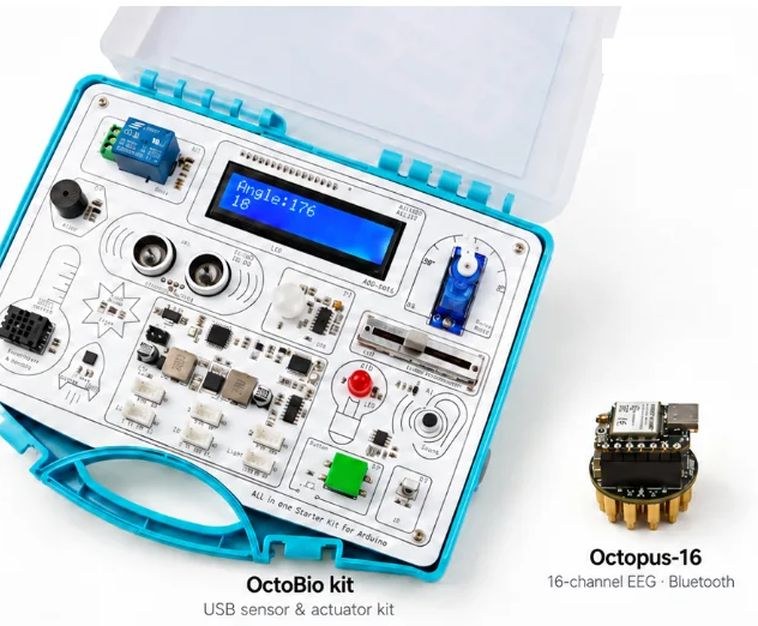
The OctoBio Kit is not a medical device. It is a learning and experimentation tool. Focus and relax are uncalibrated classroom indicators. Read Safety before anyone puts it on.
At a glance
| EEG channels | 16, dry spring-loaded pogo pins |
| Converters | 2 × TI ADS131M08, 24-bit |
| EEG link | Bluetooth LE, ~250 SPS |
| Hardware kit | Arduino Uno compatible, USB serial |
| Programming | Drag-and-drop blocks, 5 levels |
| Runs in | Desktop Chrome or Edge |
How it works
Two devices, one browser tab.
| Brain side | Room side | |
|---|---|---|
| Device | Octopus 16 EEG board | Elecrow All-in-One Starter Kit for Arduino (SEA0004T) |
| Link | Web Bluetooth | Web Serial (USB), 115200 baud |
| Role | Reads the EEG signal. The browser turns it into band power. | Senses the room and acts on it: lights, servo, buzzer, relay, screen. |
 Octopus 16 ──Bluetooth──►┐
                          │   octobridge.pieeg.com    ┌──► LEDs, servo, buzzer,
                          ├──►  (Chrome / Edge tab)   ┤    relay, 16×2 LCD
 Starter kit ────USB─────►┘   blocks:  if → then      └──◄ light, distance, PIR,
                                                           temp, soil, knob …
The web app reads both devices at the same time and links them with your blocks. You can also use either device on its own.
- Connect: Bluetooth and USB, both live at once.
- Build: drag-and-drop blocks.
- Run: watch the hardware respond. Nothing to compile.

What students learn
Biology, electronics and programming in one experiment, with the same setup from primary school to university.
- Biology: brain rhythms (delta, theta, alpha, beta, gamma), why alpha rises when the eyes close, and the artifacts that blinks and jaw clenches leave in the signal.
- Electronics: sensors and actuators, analog vs digital, I²C, serial communication, units and ranges.
- Programming: if / else, loops, thresholds, mapping one range onto another, and combining two signals into one decision.
Get started
Related
- octoBridge: the browser lab that runs the kit
- Octopus 16: hardware details of the EEG board
- JavaScript SDK: use the Octopus 16 in your own web app (
octopus-16)
Support
Support for the OctoBio software, firmware and the Octopus 16 comes from the PiEEG team:
- Discord: discord.gg/5Ps24p47 (opens in a new tab)
- GitHub: github.com/pieeg-club (opens in a new tab)
- Email: pieeg@pieeg.com