Signals & Datasets
Example recording
20 seconds from the JNEEG example dataset, all 8 channels, band-pass filtered to 1–40 Hz. The large bursts that appear on many channels at once are artifacts such as blinks, chewing or movement. Between them is the ongoing EEG.
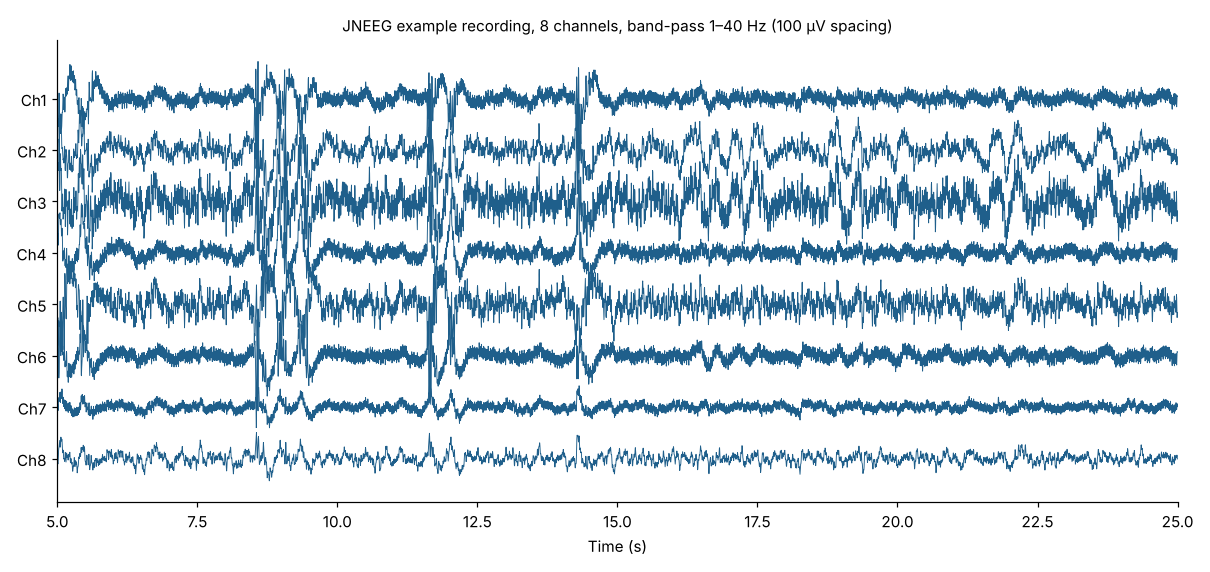
Learn to recognise artifacts before you analyse anything. Remove or mark them before computing band power or training a model.
Dataset
In GUI/dataset (opens in a new tab) of the JNEEG repository, saved by 2.Save_data.py.
| File | Content | Size |
|---|---|---|
output1.xlsx | Raw EEG in µV, columns data_1ch_test…data_8ch_test | 8 channels, 10,000 samples (40 s at 250 SPS) |
Plot it with Data_visualisation.py (opens in a new tab). The raw values carry a DC offset, so apply a band-pass filter (for example 1–40 Hz) first, as in the chart above.
Project ideas for the Jetson Nano
The GPU makes JNEEG a good fit for projects that need real-time inference:
- Eyes-closed detector: compute alpha power once per second and switch something on when it rises.
- Blink and jaw-clench control: detect artifacts on the front channels and use them as buttons for a robot or a game.
- EEG + camera: combine a webcam model (face, hand or object detection) with EEG features in one app.
- Mental-state classifier: train a small network on band-power features and run it on the GPU. Start from the PiEEG-16 machine-learning example.