PiEEG-8
Turn a Raspberry Pi into an 8-channel brain-computer interface.
PiEEG-8 is an open-source shield that plugs straight onto the Raspberry Pi 40-pin header. It reads up to 8 channels of biosignals (EEG, EMG and ECG) through a Texas Instruments ADS1299 front end, and the Pi streams, records and processes the data in real time. Hardware, SDK and server software are all open source.
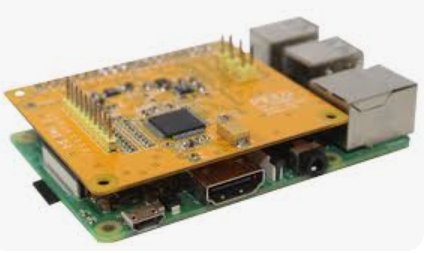
PiEEG-8 is not a medical device. It is a tool for research, education and engineering. Run it from a 5 V battery only, never from the mains. Read Safety before the first recording.
At a glance
| Channels | 8 biosignal inputs, plus reference and bias |
| Converter | TI ADS1299, 24-bit, simultaneous sampling |
| Sample rate | 250 SPS (default) |
| Signals | EEG, EMG, ECG |
| Host | Raspberry Pi 4 or Raspberry Pi 5 |
| Link to the Pi | SPI0 on the 40-pin GPIO header |
| Electrodes | Dry or wet Ag/AgCl, 2.54 mm header |
| Software | PiEEG Server, Python SDK, BrainFlow |
| Power | 5 V battery (power bank) only |
How it works
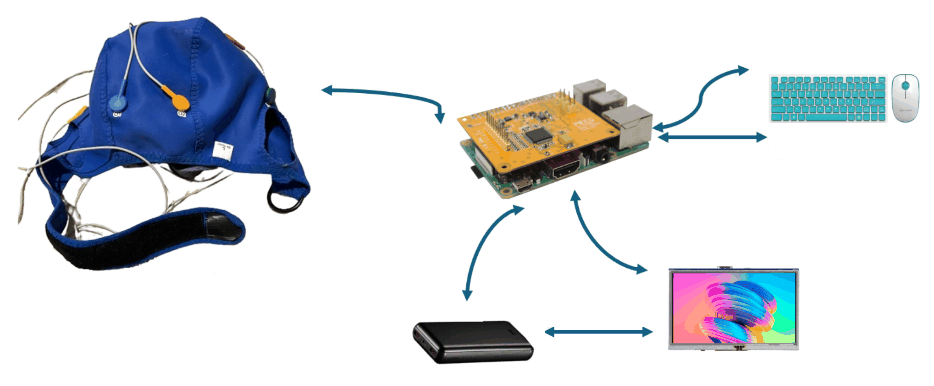
One shield, one Raspberry Pi, everything on battery power.
 Electrodes 1–8 ─┐
 Reference (ear) ┼─► PiEEG-8 ─SPI─► Raspberry Pi ─► PiEEG Server
 Bias (ear) ─────┘   (ADS1299)      4 or 5            │
                                     ▲                ├ dashboard :1617
               5 V power bank ───────┘                ├ WebSocket :1616
└ CSV · LSL · OSC- Measure: the ADS1299 digitises all 8 channels at the same moment, 250 times per second.
- Transfer: the Pi reads each sample over SPI when the board signals data ready.
- Use: PiEEG Server filters the signal, shows it in the browser and streams it to your own code.
What you can measure
| Signal | What it shows | Typical first test |
|---|---|---|
| EEG | Brain rhythms: delta, theta, alpha, beta, gamma | Close your eyes and watch alpha (8–13 Hz) rise |
| EMG | Muscle activity | Clench a fist or the jaw |
| ECG | Heart activity | Electrodes on the chest or wrists |
See real recordings in Signals & Datasets.
Who it's for
- Researchers who want raw, unfiltered 24-bit data and full control over the ADC registers.
- Students and teachers learning neuroscience, signal processing and embedded Linux on hardware they can see and modify.
- Developers building BCI apps: stream over WebSocket, LSL or OSC, or use BrainFlow.
Get started
Related
- PiEEG Server: streaming, dashboard and recording (
--device pieeg8) - PiEEG-16: the 16-channel version of this shield
- Noise elimination: getting a clean signal
- GitHub: PiEEG-8 (opens in a new tab): SDK scripts, datasets and manuals
Citation
If you use PiEEG-8 in research, please cite:
I. Rakhmatulin et al. PIEEG: Turn a Raspberry Pi into a Brain-Computer-Interface to measure biosignals. arXiv:2201.02228, 2022. arxiv.org/abs/2201.02228 (opens in a new tab)
I. Rakhmatulin et al. Raspberry Pi Shield – for measure EEG (PIEEG). 2021 5th International Conference on Electrical, Electronics, Communication, Computer Technologies and Optimization Techniques (ICEECCOT), pp. 410–413. DOI: 10.1109/ICEECCOT52851.2021.9707969 (opens in a new tab)
Support
- Discord: discord.gg/5Ps24p47 (opens in a new tab)
- GitHub: github.com/pieeg-club (opens in a new tab)
- Email: pieeg@pieeg.com