Signals & Datasets
What real Octopus 16 recordings look like, and open data to practise with. All recordings use the built-in dry pogo pins at 250 samples per second.
Example signals
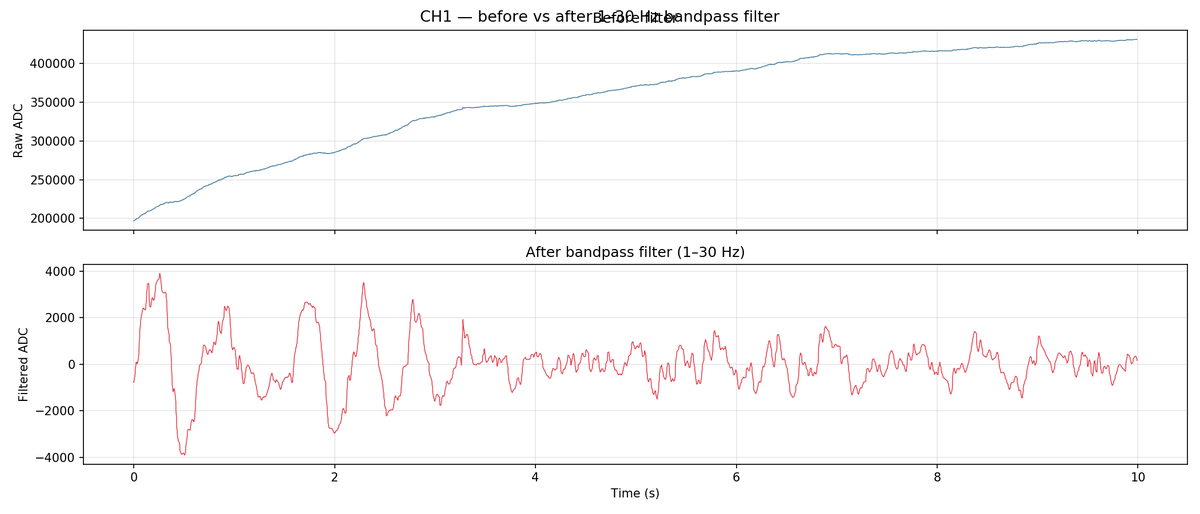
Blinking test, sensor over Fp
Sensor on the forehead. The top plot is the raw signal, with its slow drift. The bottom plot is the same signal after a band-pass filter: each blink is a clear spike.
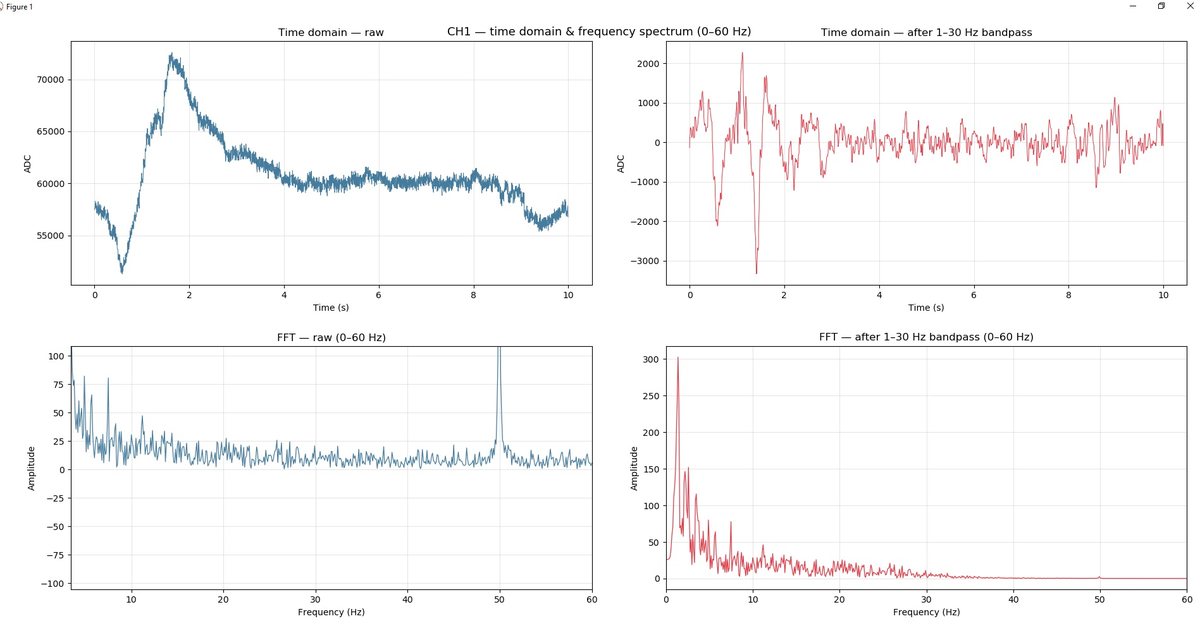
Alpha test, sensor over Pz
Eyes closed, sensor on the top-back of the head. The spectrum shows a peak in the alpha band (8–13 Hz).
Blinks and jaw clenches are muscle, not brain activity. Learn to recognise them before you analyse anything.
Datasets
In the Dataset (opens in a new tab) folder of the Octopus 16 repository. Each file has a Raw data sheet and an Info sheet.
| File | Content | Size |
|---|---|---|
Blinking_Fp.xlsx | Blinking, sensor over Fp | 2,503 samples (about 10 s), 16 channels |
closed_eys_Pz.xlsx | Eyes closed, sensor over Pz | 2,503 samples (about 10 s), 16 channels |
open_yeys_Pz.xlsx | Eyes open, sensor over Pz | 2,503 samples (about 10 s), 16 channels |
Columns: Time (s), Counter (packet counter, 0–255), CH1…CH16.
The channel values are raw ADC counts, not µV. Multiply by about 0.0358 to get µV. See Specification.
Try it: compare closed_eys_Pz.xlsx with open_yeys_Pz.xlsx. The eyes-closed file should show more power at 8–13 Hz. FFT.py (opens in a new tab) plots the spectrum of one channel.
Projects
- Classroom lessons: one condition, one action, for example "eyes closed → LED on". See OctoBio Kit lessons.
- Neurofeedback game controller: the ESP32-S3 firmware in the repository can also act as a Bluetooth or USB gamepad, turning EEG features into joystick movement. See Firmware.
- Your own web app: use the JavaScript SDK with
device: 'octopus-16'.