What's in the Box
Included
| Item | Details |
|---|---|
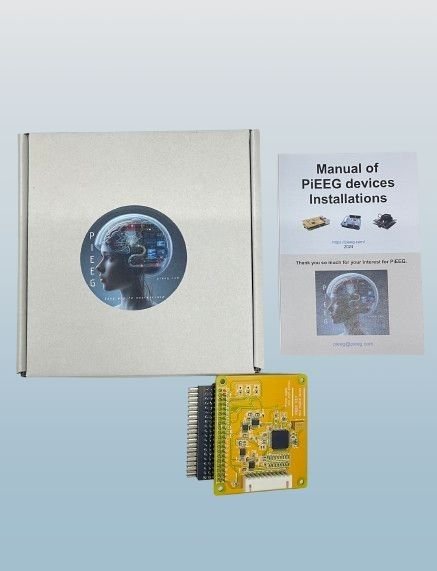
| 1 × PiEEG-8 shield | 8-channel ADS1299 board with 40-pin Raspberry Pi header and 2.54 mm electrode header |
| Quick-start manual | Printed installation guide for PiEEG devices |
Not included
| Item | Requirements | More |
|---|---|---|
| Raspberry Pi | Raspberry Pi 4 or Raspberry Pi 5, with a microSD card (16 GB or more) and Raspberry Pi OS | How to Start |
| 5 V power bank | 5 V output, 3–3.5 A, capacity up to 10,000 mAh. Powers the Pi, the shield and the monitor. | Power bank |
| Electrodes | 8 EEG electrodes (dry or wet Ag/AgCl) with 2.54 mm connectors, plus 2 ear-clip electrodes for reference and bias | Electrodes |
| EEG cap | Holds the electrodes in place on the scalp (10-20 system). Ready-made nylon cap or DIY. | Cap |
| Monitor | Portable monitor powered from the power bank or the Pi, never from a wall socket | Safety |
| Keyboard and mouse | Wired USB. Wireless devices add radio noise. | Noise elimination |
| Conductive gel | Only for wet electrodes | Electrodes |
Headless option: you can skip the monitor, keyboard and mouse and open the PiEEG Server dashboard from a laptop on the same network. The laptop must run on battery and must never be cabled to the Pi or the electrodes.
⚠️
Battery only. Every device that is cabled to the PiEEG-8 (the Pi, the monitor, the keyboard) must run from the power bank. Never use a wall charger, a desk power supply or a USB port of a mains-powered computer.
Checklist
- PiEEG-8 shield
- Raspberry Pi 4 or 5 with Raspberry Pi OS on a microSD card
- Charged 5 V / 3 A power bank and a short, thick USB cable
- 8 electrodes and 2 ear clips
- EEG cap (and gel if you use wet electrodes)
- Battery-powered monitor, wired keyboard and mouse (or a battery-powered laptop for headless use)
Next: How to Start