Electrodes & Mounting
Mounting on the Nucleo
MicroBCI plugs onto the NUCLEO-WB55 headers. Unplug the board first, line the shield up with the end pin marked by the arrow, and press it down evenly.
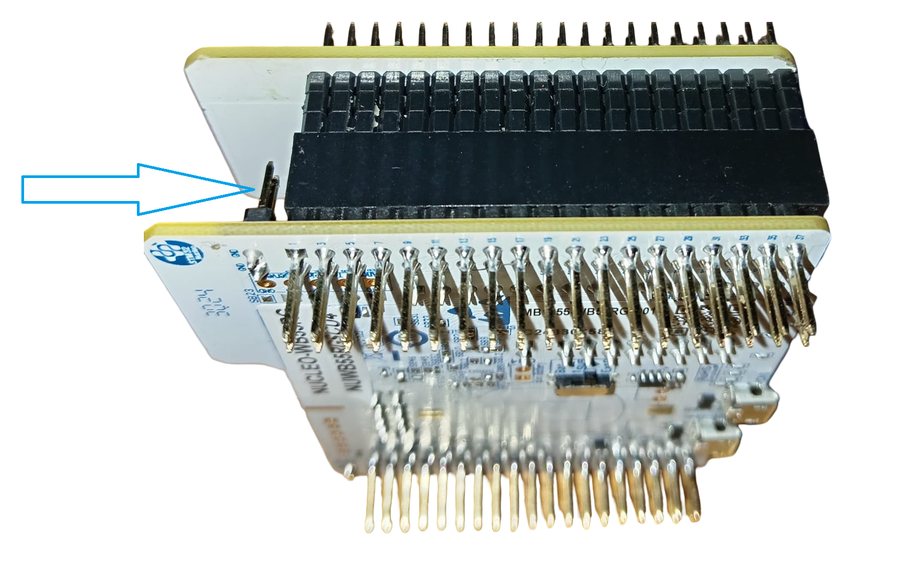
Pay attention to the right connection. If the shield is shifted by one pin, the board won't read the ADS1299. Check the alignment against the photo every time you mount it.
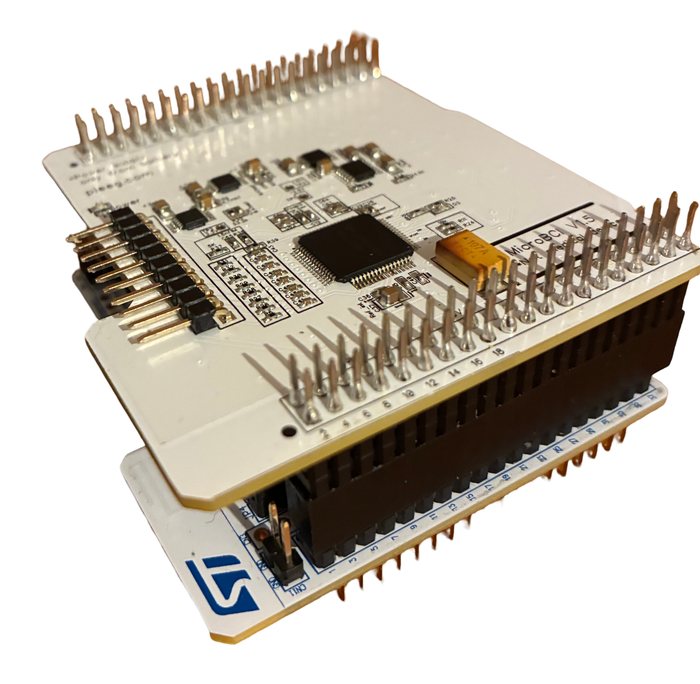
The pins the Nucleo uses are shown in the official board documents in the repository: NUCLEO-WB55 schematic (opens in a new tab) and Nucleo kit datasheet (opens in a new tab).
Electrode connections
MicroBCI has three kinds of electrode inputs.
| Input | Count | Electrode | Purpose |
|---|---|---|---|
| Channels 1–8 | 8 | Dry or wet Ag/AgCl, in the cap | Each channel measures the voltage between its electrode and the reference |
| Reference | 1 | Ear clip on one earlobe | The common 0 µV point that all 8 channels are measured against |
| Bias | 1 | Ear clip on the other earlobe | Actively drives the body to cancel common-mode noise such as 50/60 Hz mains hum |
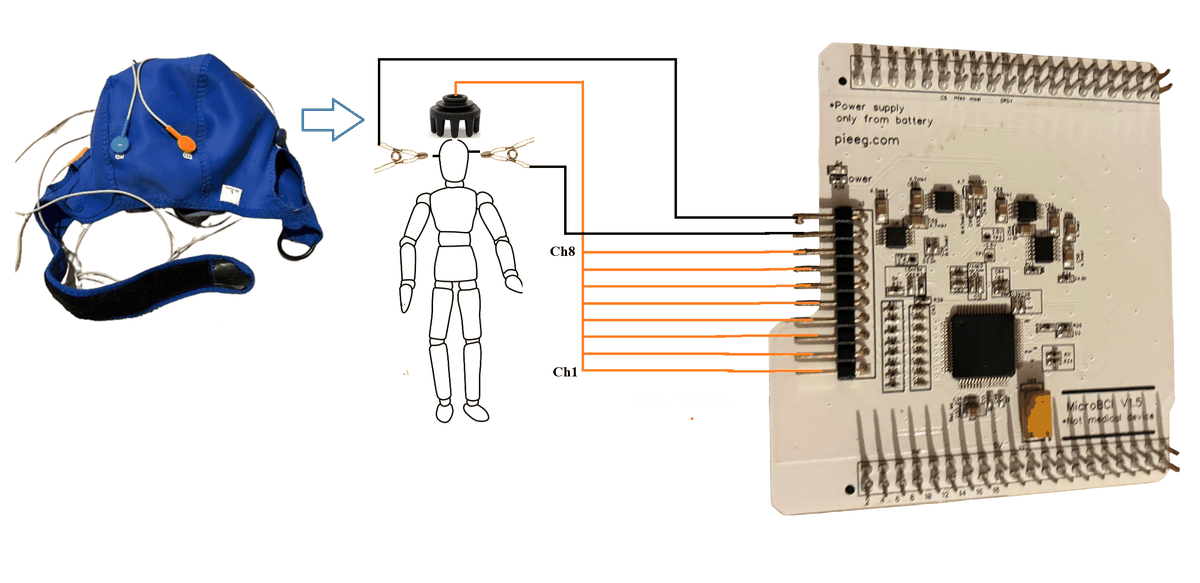
The electrode header is a standard 2.54 mm pin header, so most EEG cables with 2.54 mm (0.1") female connectors fit. Kits: dry-electrode EEG cap (opens in a new tab), wet-electrode EEG cap (opens in a new tab), EMG / ECG kit (opens in a new tab).
The reference and bias clips matter most. A loose ear clip makes every channel noisy at once. Clean the earlobes and make sure both clips sit firmly.
Suggested montage
Place the electrodes on the 10-20 system. This layout is the PiEEG 8-channel default:
| Channel | Position | Area | Good for |
|---|---|---|---|
| 1 | Fp1 | Front left | Blinks, eye movement |
| 2 | Fp2 | Front right | Blinks, eye movement |
| 3 | C3 | Centre left | Motor activity (right hand) |
| 4 | C4 | Centre right | Motor activity (left hand) |
| 5 | P7 | Back left, side | Parietal and temporal activity |
| 6 | P8 | Back right, side | Parietal and temporal activity |
| 7 | O1 | Back left | Alpha rhythm, vision |
| 8 | O2 | Back right | Alpha rhythm, vision |
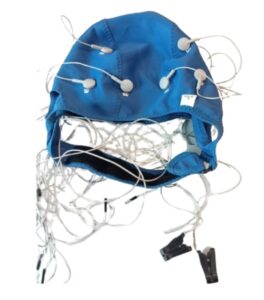
You can use any other positions. Keep a note of which channel went where.
For EMG or ECG, place the 8 electrodes over the muscles (or on the chest) you want to measure, with the reference and bias on a bony spot nearby, such as the wrist or elbow.