Specification
Everything you need to know about the hardware, plus the Bluetooth protocol for writing your own software.
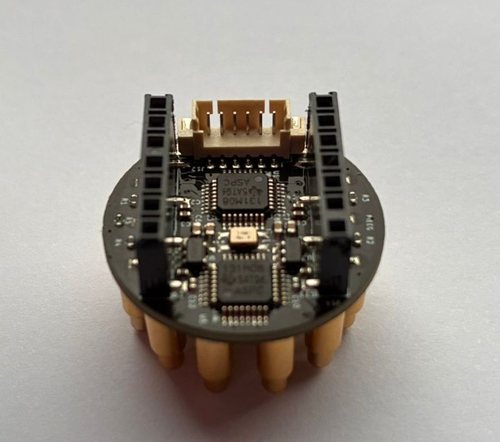
Signal acquisition
| Converters | 2 × Texas Instruments ADS131M08 |
| Type | 24-bit, 8-channel, simultaneous-sampling, delta-sigma |
| Channels | 16 (8 per converter) |
| Gain | 4 on all channels (set in firmware; the ADS131M08 supports 1 to 128) |
| DC block | ADS131M08 built-in DC-block filter on (about 1 Hz) |
| Reference voltage | 1.2 V internal |
| Clock | External 8.192 MHz oscillator |
| Oversampling ratio | 16384 |
| Sample rate | 250 SPS (8.192 MHz ÷ (2 × 16384)) |
| Interface | Shared SPI bus, a chip select per converter, shared RESET, DRDY from converter 1 as the sync master |
Sample rate on some boards: boards fitted with an 8.000 MHz clock run at about 244 SPS (4 MHz ÷ 16384), even though the stream is labelled 250. That is fine for viewing and band power. Correct for it if you need precise timing (ERP, P300).
Electrode array
| Contacts | Spring-loaded pogo pins, ⌀ 4 × 11 mm |
| Total pins | 18: 16 signal, 1 reference (AINREF), 1 ground (GND) |
| Pitch | About 5.38 mm, hexagonal packing |
| Array span | About 20.3 × 20.3 mm |
| Reference / ground | Selectable by jumpers for single-board or stacked use |
Board and controller
| Board | Round, 26.0 mm diameter, 4 layers |
| Controller | Seeed Studio XIAO ESP32-S3 (not included) |
| Radio | Bluetooth LE 5, 2M PHY |
| Power | 5 V power bank via the XIAO's USB-C, no more than 2 A. Battery only while worn. |
| Isolation | None |
| 3D models | Thingiverse (opens in a new tab) |
BLE protocol
| Advertised name | Octopus-16-XXXX (official firmware) |
| Service | 4fafc201-1fb5-459e-8fcc-c5c9c331914b |
| Data characteristic (notify) | beb5483e-36e1-4688-b7f5-ea07361b26a8 |
| Command characteristic (write + notify) | c0de0001-36e1-4688-b7f5-ea07361b26a8: register bridge to read and write ADC registers |
Packet: 51 bytes, one sample per notification
| Bytes | Content |
|---|---|
[0] | 0xA0 start marker |
[1] | Sample counter (0–255, wraps) |
[2..25] | ADC 1, channels 1–8 (8 × 3 bytes, 24-bit big-endian two's complement) |
[26..49] | ADC 2, channels 9–16 |
[50] | 0xC0 end marker |
Use the sample counter to spot lost packets.
Converting to microvolts
1.2 V reference, gain 4, 24-bit:
raw = (b[0] << 16) | (b[1] << 8) | b[2]   # 3 bytes of one channel
if raw & 0x800000:                       # negative value
    raw -= 1 << 24
uV = raw * (1.2 / 4.0 / 8388607) * 1e6   # about 0.0358 µV per count
Minimal Python reader
import asyncio
from bleak import BleakScanner, BleakClient

SERVICE = "4fafc201-1fb5-459e-8fcc-c5c9c331914b"
DATA    = "beb5483e-36e1-4688-b7f5-ea07361b26a8"
SCALE   = 1.2 / 4.0 / 8388607 * 1e6

def on_data(_, p):
    if len(p) != 51 or p[0] != 0xA0 or p[50] != 0xC0:
        return
    uv = []
    for c in range(16):
        b = p[2 + 3*c: 5 + 3*c]
        raw = (b[0] << 16) | (b[1] << 8) | b[2]
        if raw & 0x800000:
            raw -= 1 << 24
        uv.append(raw * SCALE)
    print(p[1], [round(v, 1) for v in uv[:4]], "...")

async def main():
    dev = await BleakScanner.find_device_by_filter(
        lambda d, adv: SERVICE in [u.lower() for u in adv.service_uuids])
    async with BleakClient(dev) as client:
        await client.start_notify(DATA, on_data)
        await asyncio.sleep(10)

asyncio.run(main())
In a browser, the easiest path is the JavaScript SDK: eeg.connectBLE({ device: 'octopus-16' }).