EasyEXG
Muscle, heart, eye and brain signals on any ADC pin.
EasyEXG is a small open-source analog front end for biosignals. Plug in a standard 3-lead electrode cable, connect three wires to your microcontroller, and read EMG (muscle), ECG (heart), EOG (eye movement) or EEG (brain rhythm) with a plain analogRead(). It runs from 3.3 V or 5 V and gives one analog output centred at VCC/2, so it works with Arduino, ESP32, ESP8266, STM32, Raspberry Pi Pico and any other board with an ADC.
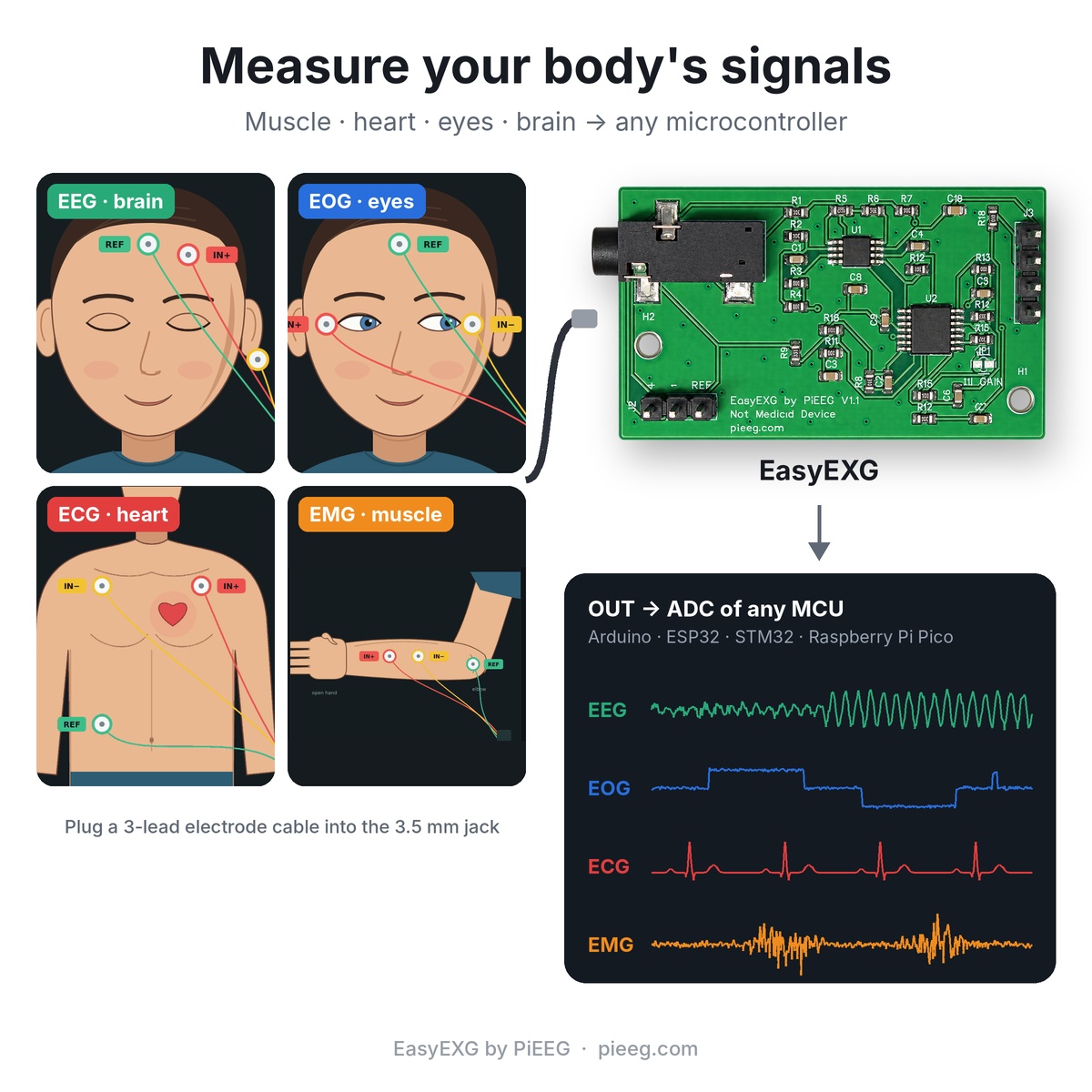
EasyEXG is not a medical device. It has no isolation: while electrodes are on a person, everything connected to it must run on battery (power bank, laptop with the charger unplugged). Read Safety first.
At a glance
| Channels | 1 differential input (IN+, IN−) plus reference / driven right leg |
| Signals | EMG, ECG, EOG, EEG |
| Amplifiers | TI INA333 instrumentation amplifier + TI OPA4388 quad op-amp |
| Gain | 221× (JP1 open) or 1 048× (JP1 bridged) |
| Bandwidth | 0.16–500 Hz (−3 dB) |
| Output | 1 analog signal, centred at VCC/2 |
| Supply | 3.3 V or 5 V (max 5.5 V) |
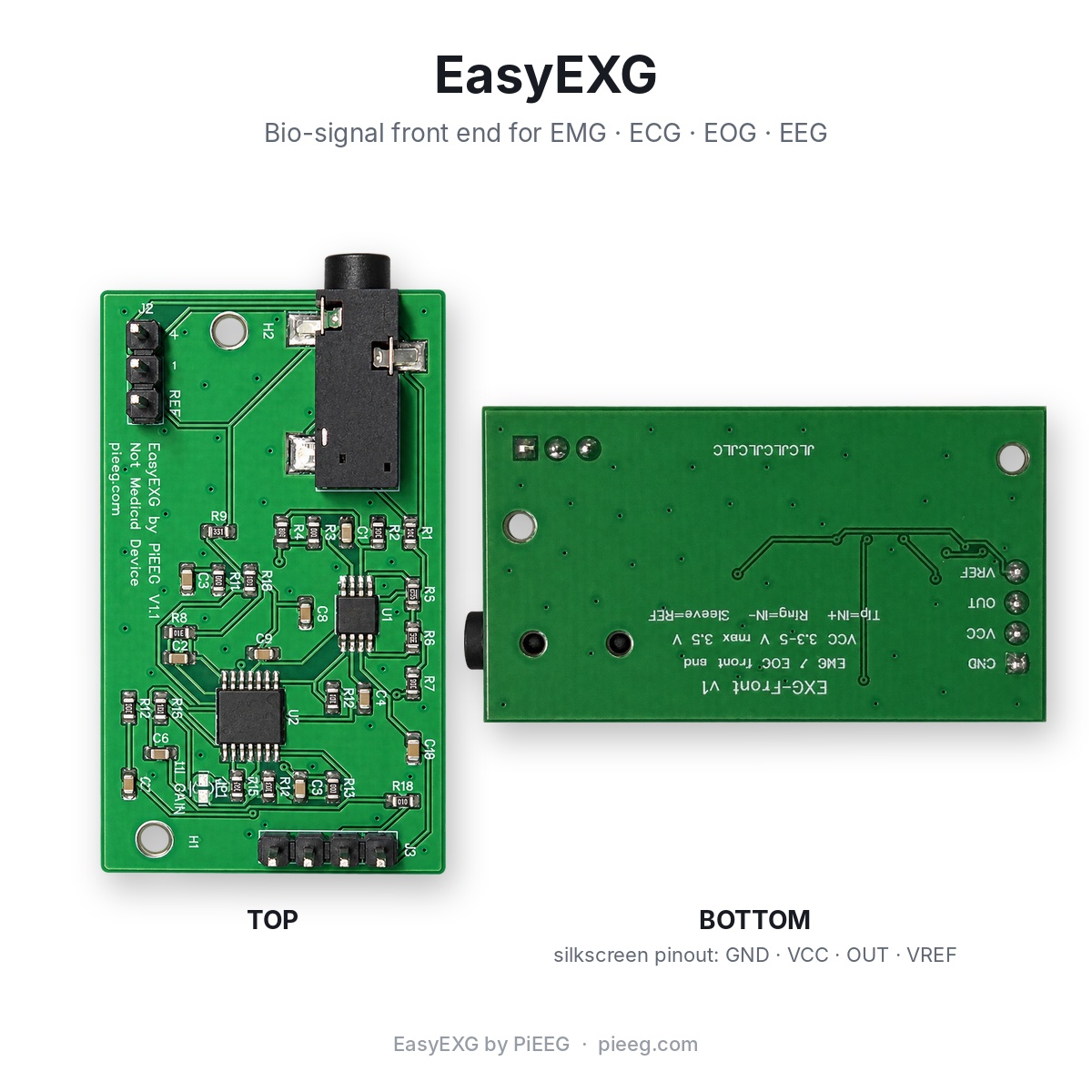
| Electrodes | 3.5 mm jack for 3-lead snap cables, or a 3-pin 2.54 mm header |
| Host | Any microcontroller with an ADC (not included) |
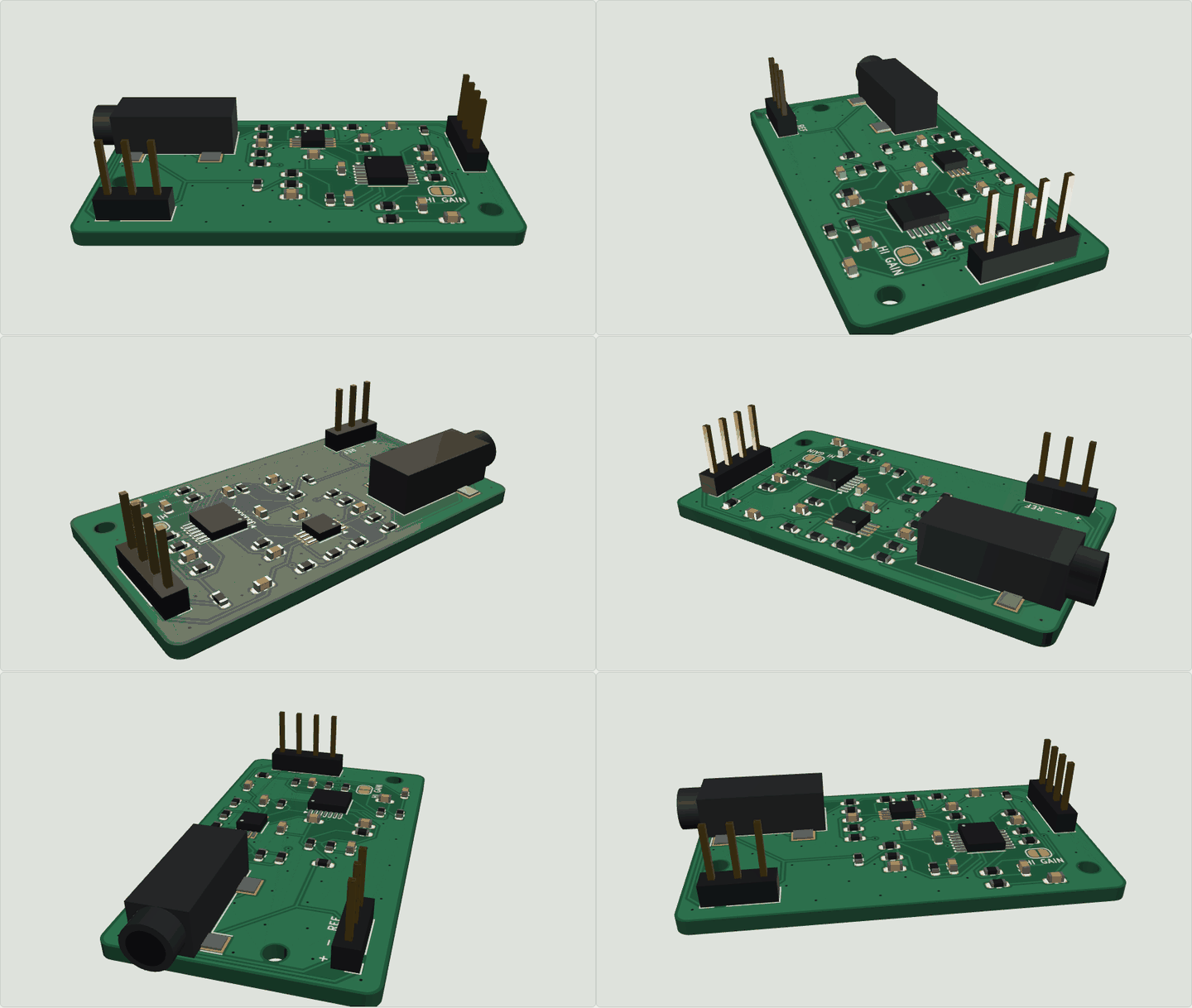
| Size | 46 × 26 mm, 2 × M2 mounting holes |
| Software | Arduino sketches (USB and Wi-Fi) + Python viewer |
The board
How it works
 IN+ ─┐
 IN− ─┼─► EasyEXG ──OUT (analog)──► ADC of your MCU ──USB or Wi-Fi──► Serial Plotter
 REF ─┘   INA333 + OPA4388           Arduino · ESP32 ·                  or Python viewer
          gain 221× / 1 048×         STM32 · Pico
0.16–500 Hz- Amplify: the INA333 picks up the tiny difference between IN+ and IN− (microvolts to millivolts) and rejects mains hum (CMRR ≥ 100 dB).
- Filter: the OPA4388 removes slow drift (0.16 Hz high-pass), adds more gain and cuts noise above 500 Hz. It also drives the reference electrode to cancel common-mode noise (driven right leg).
- Read: the output sits at VCC/2 with no signal and swings up and down with the biosignal. Your microcontroller samples it with its ADC.
What you can measure
| Signal | What it shows | JP1 | Typical first test |
|---|---|---|---|
| EMG | Muscle activity | Open · 221× | Clench your fist: bursts appear |
| ECG | Heart activity | Bridged · 1 048× | Electrodes on the chest: a heartbeat every second |
| EOG | Eye movement | Open · 221× | Look left and right: the trace steps |
| EEG | Brain rhythm (alpha) | Bridged · 1 048× | Close your eyes: alpha (8–12 Hz) grows |
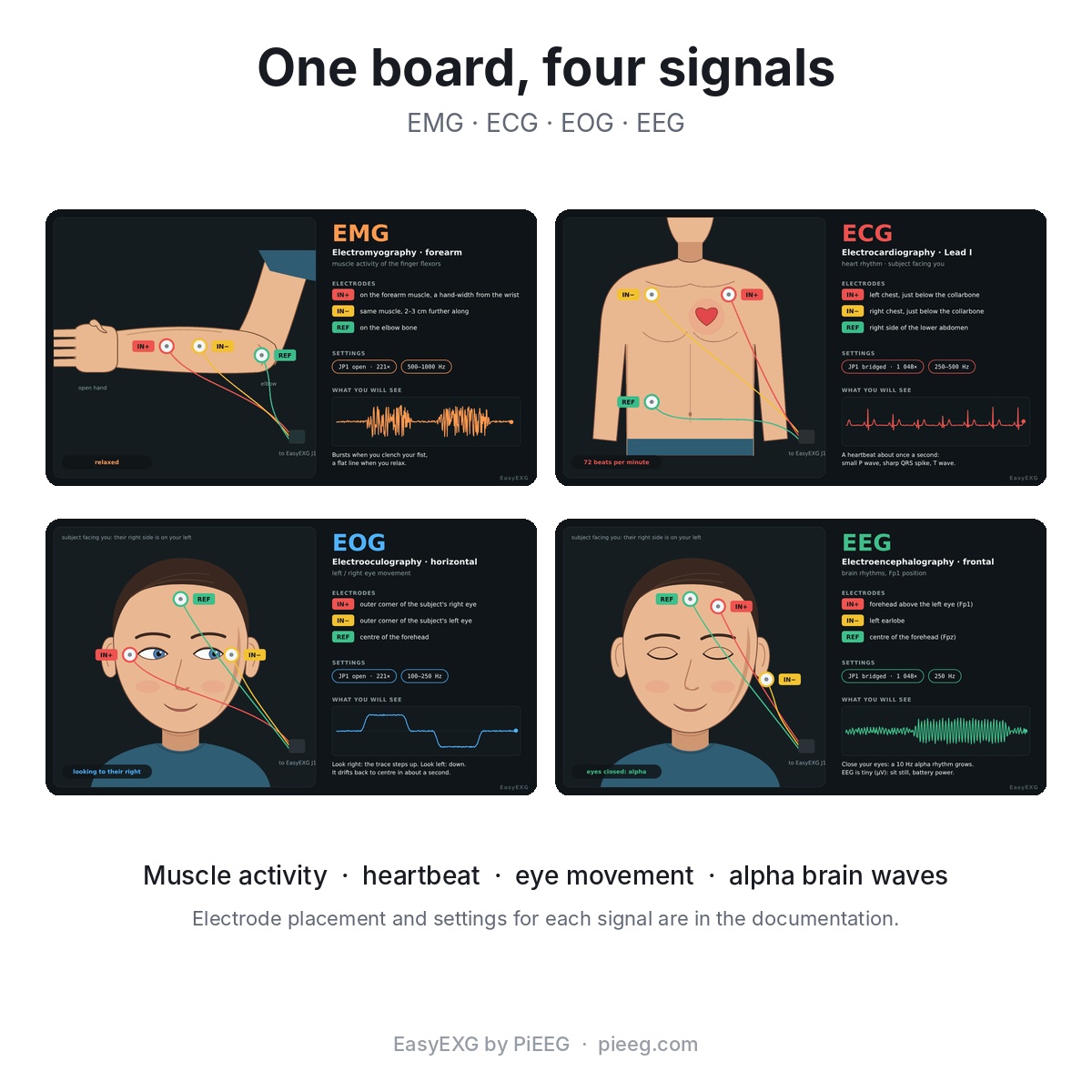
Electrode positions for each signal: Electrode Placement.
EasyEXG or ardEEG?
| EasyEXG | ardEEG | |
|---|---|---|
| Channels | 1 | 8 |
| Output | Analog, read by your MCU’s ADC | Digital, 24-bit ADS1299 |
| Host | Any MCU with an ADC | Arduino UNO R4 WiFi |
| Best for | EMG, ECG, EOG, first EEG experiments, embedded projects | Multi-channel EEG |
| Electrodes | 3-lead snap cable (3.5 mm jack) | 8 electrodes + 2 ear clips |
Get started
Related
- GitHub: EasyEXG : schematic, Gerbers, 3D model, Arduino and Python software
- Electrodes and Power bank
- Noise elimination: getting a clean signal
- ardEEG: 8-channel EEG with an Arduino
Licence
CC BY-NC 4.0 (Creative Commons Attribution–NonCommercial). Hardware use is subject to the PiEEG liability notice .
Support
- Discord: discord.gg/5Ps24p47
- GitHub: github.com/pieeg-club
- Email: pieeg@pieeg.com